How to Read a Health Plan's Summary of Benefits and Coverage
Every health plan must provide a summary of benefits and coverage (SBC) in a standard format. A walkthrough of network rules, cost sharing, exclusions and the coverage examples.

Updated November 14, 2026 · 6 min read
Key takeaways
- The SBC is a standard summary every health plan must provide, so you can compare plans side by side.
- The first page shows the deductible, out-of-pocket limit and whether you need referrals.
- The coverage examples estimate your costs for a baby's birth, managing diabetes and a fracture.
- Check the list of excluded services and other covered services near the end.
What to look for on an SBC
Illustrative exampleWalking through the SBC
| Section | What to look for |
|---|---|
| Important questions (page 1) | Deductible, services covered before the deductible, out-of-pocket limit, what doesn't count toward it, network, referrals |
| Common medical events | What you pay for visits, tests, drugs by tier, outpatient surgery, emergency care, hospital stays, mental health, pregnancy |
| In-network vs. out-of-network columns | Out-of-network costs or "not covered" |
| Limitations and exceptions | Prior authorization, visit limits |
| Excluded services | Things the plan won't pay for |
| Rights to continue coverage and appeal | Contacts for help |
| Coverage examples | Estimated total costs for standard scenarios |
Using the coverage examples
Fictional sample
Each SBC estimates what you'd pay for the same scenarios, like having a baby, managing type 2 diabetes for a year and a simple fracture. Fictional example: Plan A shows $4,200 for having a baby and Plan B shows $2,800. That's a quick way to compare cost sharing, though it doesn't include premiums.
Free, no obligation, about two minutes.
Or call 1-877-519-5911
Checklist
- Deductible and out-of-pocket limit for you and your family
- Whether your doctors are in network (the SBC won't tell you; check the directory)
- Drug tiers and costs for your prescriptions
- Referral and prior authorization rules
- Excluded services you might need
- Coverage example costs, plus a year of premiums
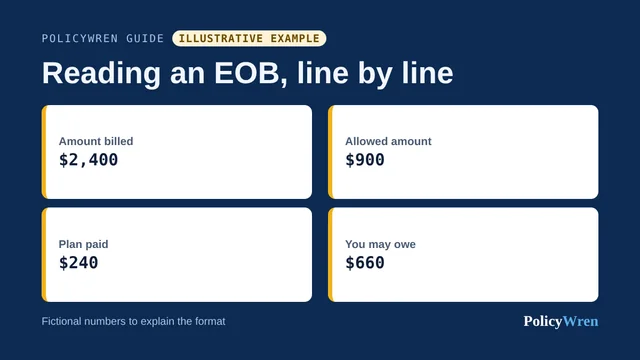
See how to choose a plan and how to read an EOB.
Free, no obligation. Call 1-877-519-5911 to speak with a licensed health insurance agent about plans for people under 65.
Frequently asked questions
Where do I get the SBC?
On HealthCare.gov or your state exchange plan listings, from your employer or from the insurer. You can request one for free.
Is the SBC the full contract?
No. It's a summary. The full policy has the binding terms.
Do short-term plans have an SBC?
No. SBCs are required for ACA-regulated health coverage.
Sources
How this guide was made: researched and drafted with AI assistance (Wren AI), checked against the sources listed above, and approved for publication by the Wren AI team. Wren AI is an AI research tool, not a licensed insurance agent.
This guide is general information, not insurance, legal, tax or medical advice. Coverage, rules and prices vary by state, insurer and policy. Confirm details with a licensed agent or the official source before you buy. Read our editorial policy.