
Health insurance · Updated November 2026
Compare health insurance plans and see if you qualify for savings.
Lost job-based coverage or facing a premium increase? Tell us about your household and a licensed agent will walk you through plans and any subsidies you may qualify for.
Prefer to talk? Call a licensed agent: 1-877-519-5911
Free to use. No obligation. Takes about 2 minutes.
| Metal tier | Silver |
| Actuarial value | 70% |
| Annual deductible | $4,500 |
| Out-of-pocket max | $9,200 |
| Network | PPO |
| Est. monthly premium | Compare → |
Start with your situation
Know the difference
Premium, total cost, network and eligibility
Premium
What you pay each month to have the plan, whether or not you use care. A premium tax credit can lower it.
Total cost
Premiums plus what you pay for care: deductible, copays and coinsurance, up to the out-of-pocket maximum. How it adds up
Network
The doctors, hospitals and pharmacies the plan covers. HMOs and EPOs usually don't cover out-of-network care. Network types
Eligibility
When you can enroll (open enrollment or a qualifying life event) and whether your income qualifies for savings. Enrollment rules
Plan selection checklist
Before you pick a plan
For 2027, open enrollment on HealthCare.gov runs November 1, 2026 to January 15, 2027. Pick a plan by December 15 for coverage starting January 1.
Compare 2027 plans
- Your doctors and hospital are in the plan's network
- Your prescriptions are on the formulary, and you know their tier
- You compared yearly premiums plus a light-year and worst-case cost
- You could afford the deductible if you need care early in the year
- You checked Silver plans if your income may qualify for cost-sharing reductions
- Your 2027 income estimate is up to date
- The plan is comprehensive ACA coverage, not a short-term or fixed-indemnity product
Coverage
Health plan terms, decoded
- Bronze plan
60% - Lowest premiums, highest costs when you get care. The plan pays about 60% of covered costs on average.
- Silver plan
70% - Moderate premiums. If your income qualifies, cost-sharing reductions lower your deductible.
- Gold plan
80% - Higher premiums, lower deductibles. A good fit if you use care regularly.
- Platinum plan
90% - Highest premiums and lowest out-of-pocket costs.
- Premium tax credit
APTC - A subsidy that lowers your monthly premium based on household income and size.
- HMO / PPO / EPO
- Network types. HMOs require referrals; PPOs let you see out-of-network doctors for more; EPOs have no referrals but no out-of-network coverage.
- Special enrollment period
SEP - A 60-day window to enroll outside open enrollment after a qualifying event like losing coverage or moving.
Pricing
What sets your price, your savings and when you can enroll
These are three separate questions. Mixing them up is a common reason people pick the wrong plan or miss a deadline.
What sets the premium
For ACA individual plans, insurers can only vary the price of a given plan by:
- Age (older adults can be charged up to 3 times more than younger adults)
- Location (your county or rating area)
- Tobacco use (up to 50% more)
- Whether the plan covers just you or your family
Your health history can't be used. Prices also differ by the plan you choose: metal level, network and insurer.
What sets your savings
Premium tax credits and cost-sharing reductions depend on:
- Expected household income and household size
- The benchmark Silver plan price where you live
- Whether you can get affordable job-based coverage, Medicare or Medicaid
- Buying through HealthCare.gov or your state exchange (savings aren't available off-Marketplace)
When you can enroll
Timing doesn't change the price, but it decides whether you can buy:
- Open enrollment: November 1, 2026 to January 15, 2027 on HealthCare.gov (December 15 for January 1 coverage)
- A special enrollment period after a qualifying life event, usually within 60 days
- Medicaid and CHIP: any time
Health insurance guides
Answers before you compare
 Health insurance · 8 min read
How to Choose a Health Insurance Plan: Compare Total Cost, Not Just Premium
Compare plans by total yearly cost, doctors, hospitals and prescriptions, with a Bronze vs. Silver vs. Gold worked example.
Read guide → Health insurance · 6 min read
ACA Open Enrollment for 2027: Dates and What's Changing
Open enrollment for 2027 runs November 1 to January 15 on HealthCare.gov. Enroll by December 15 for January 1 coverage.
Read guide → Health insurance · 8 min read
Health Insurance Subsidies Explained: Premium Tax Credits for 2027
How premium tax credits and cost-sharing reductions work for 2027, the return of the 400% income limit, and what to do when income changes.
Read guide → Health insurance · 6 min read
HMO vs. PPO vs. EPO vs. POS: Health Plan Networks Explained
How HMO, PPO, EPO and POS plans differ on networks, referrals and out-of-network care, and how to confirm your doctors are covered before you enroll.
Read guide →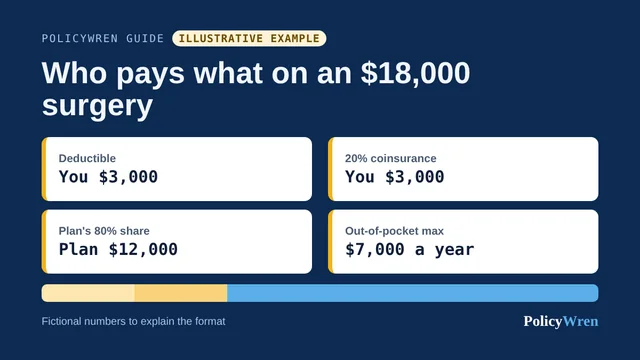 Health insurance · 6 min read
Deductible vs. Copay vs. Coinsurance vs. Out-of-Pocket Maximum
What each term means, a worked medical-bill example, and which costs don't count toward your out-of-pocket limit.
Read guide → Health insurance · 6 min read
How to Check Whether Your Doctor and Prescriptions Are Covered
Verify doctors and hospitals, read a formulary and drug tiers, and spot prior authorization and pharmacy rules before enrolling.
Read guide → Health insurance · 6 min read
Special Enrollment Periods Explained: Getting Health Insurance Outside Open Enrollment
Which life events qualify, how long you have, the documents you may need and when coverage starts.
Read guide → Health insurance · 6 min read
Health Insurance for Self-Employed People, Contractors and Gig Workers
How freelancers buy coverage, estimate income for subsidies, use the self-employed deduction and handle changing income.
Read guide → Health insurance · 6 min read
Medicaid and CHIP: Where to Start
Who Medicaid and CHIP cover, how to apply any time of year, what to have ready, and the 2027 changes for some adults.
Read guide →